Corporate wellness
Why Do Corporate Wellness Initiatives Fail? (And What Actually Works)
Most corporate wellness programs have low adoption and little lasting impact. Learn why they fail and how to build support into everyday culture.
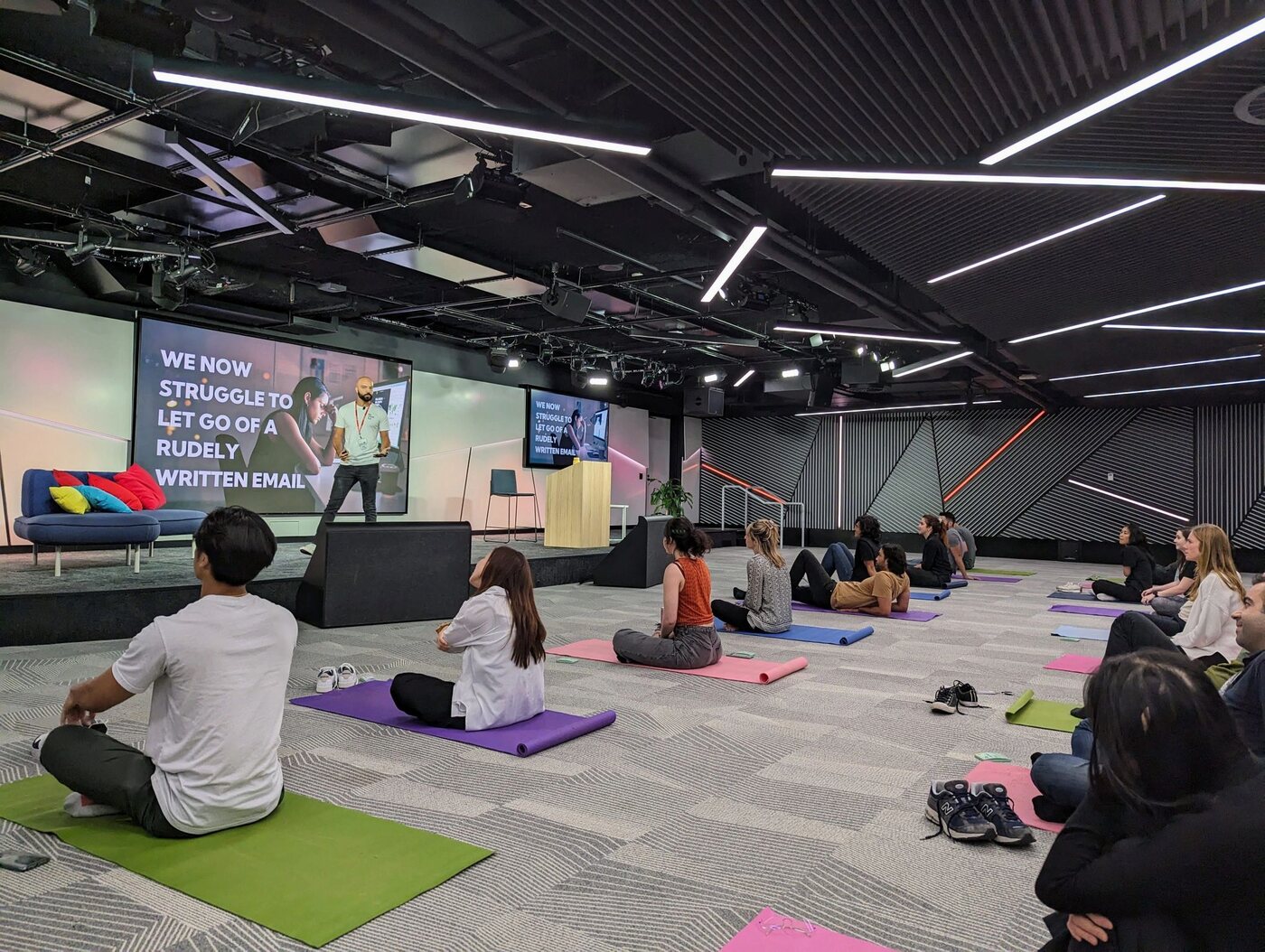
Most corporate wellness initiatives fail because they are a band aid. They arrive as a one off event, adoption stays low, and nothing underneath the program actually changes. The approaches that have a better chance of lasting are built into everyday culture, supported by empathetic leaders and reinforced by a resource people can use day to day.
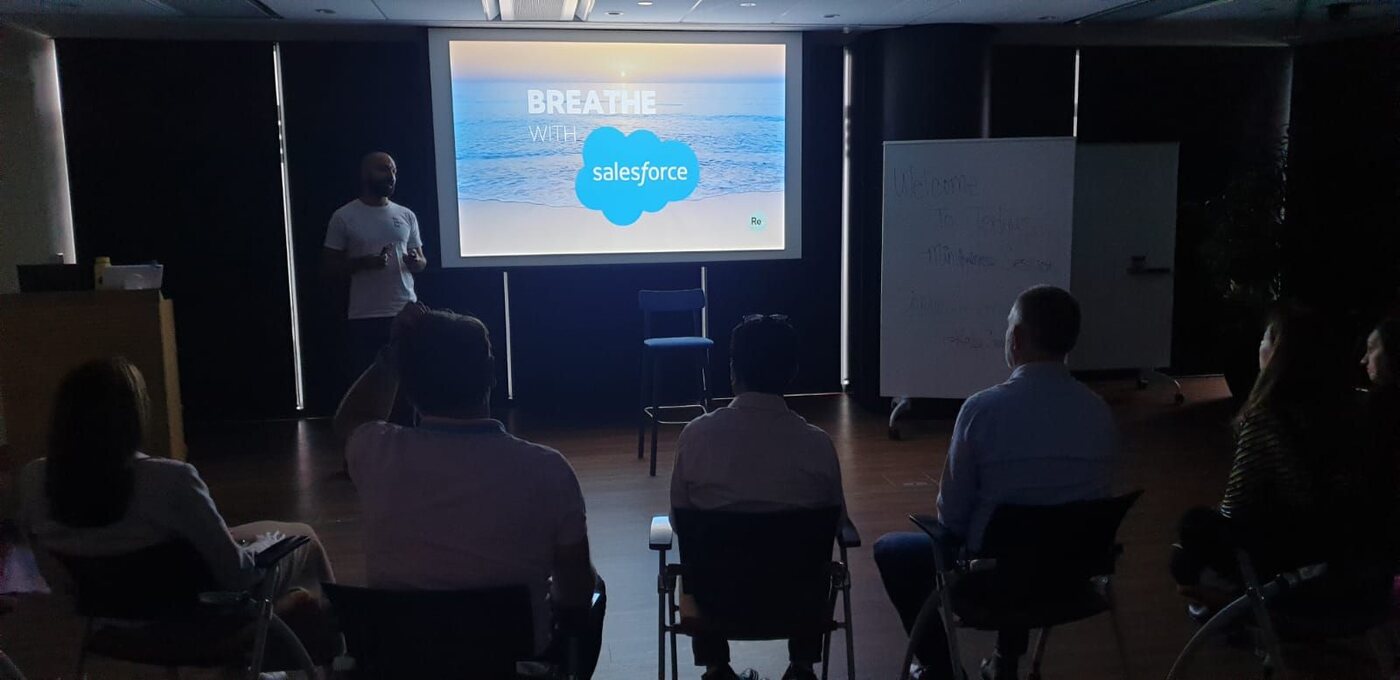
I have seen this from both sides: through my background in technology, and while taking breathwork sessions into businesses including Google, Salesforce, Spotify and other Australian teams. A strong workshop can create a reset. What happens after the room clears determines whether that reset becomes useful.
Burnout is rising, and support is not keeping up
Corporate wellness has been around for years, but the demand for better employee support keeps growing. Australian Bureau of Statistics data shows that more than two in five Australians aged 16 to 85 have experienced a mental disorder at some point in their life. Recent mental health conditions are also more common among younger age groups.
At the same time, it can be difficult for someone to find timely professional support. Employers are not expected to become healthcare providers, but they do influence what a normal working day feels like and whether people feel able to use the support available to them.
Practical self regulation tools can help people respond to pressure in the moment. Our guide to breathwork for anxiety explains how slow breathing relates to the stress response, and where its limits are.
Why band aid solutions do not stick
Many companies respond with a wellness day, a webinar or an Employee Assistance Program. EAPs provide confidential counselling and can be valuable, but average utilisation is often reported at around 5 per cent in Australia despite widespread availability among large employers. The exact number varies by workforce and provider, but the adoption gap is hard to ignore.
Low use does not prove that employees do not need help. People may not know what is available, may worry about stigma, may not believe the service is truly confidential, or may only think of it when they are already overwhelmed.
A band aid does not stop the next cut. If support is disconnected from daily work, offering it once does not change the habits, pressures or conversations that shape the rest of the year.
What teams actually want
Teams want leaders who listen, understand context and make room for people to use their own strengths. They want work to be a place where they can contribute, be creative and have an impact without feeling that every difficult day has to be hidden.
Businesses also need to be profitable. Profit is oxygen for a company, and pretending otherwise does not help employees or leaders. The useful question is not whether a business should stop caring about performance. It is how to respect performance and the people producing it at the same time.
Wellbeing and output are linked, but the proof is slow
Research often links employee wellbeing with better engagement, attendance and output. The difficult part is proving a clean cause and effect inside a real organisation, where leadership, workload, team changes and market conditions are all moving at once.
Companies can also act on one intervention and expect the numbers to change next quarter. That is rarely how behaviour change works. The benefits compound slowly. If a single session is measured like a short sales campaign, a useful program can be dismissed before it has had time to become part of how people work.
It starts with leadership
One of the strongest levers is leadership. A more empathetic, regulated and supported leader creates a trickle down effect across the team. They are more able to listen before reacting, make better decisions under pressure and give people permission to care for themselves without making it feel like a performance problem.
You cannot change every personality, but people have a range. A difficult colleague can have better and worse days. A brilliant leader can be thoughtful one day and depleted the next. The aim is to help people operate near their best more often, not to pretend that one workshop will turn everyone into a different person.
A wellness day is not a culture
The usual model is simple: book a wellness day, bring someone in, run the session and move on. The day may be enjoyable, but enjoyment is not the same as lasting adoption.
Culture appears when support stays visible. That might mean a dedicated resource, regular sessions, leaders who participate, and a shared place where people can confirm that they used a technique. Sometimes the signal matters as much as the activity. It tells employees that looking after their mental health is accepted here.
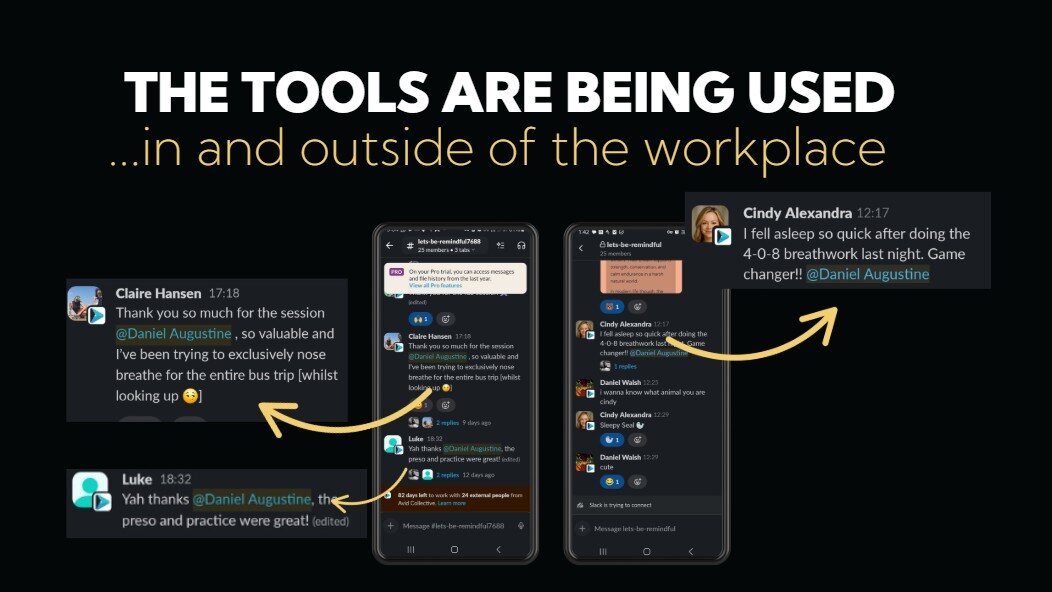
This is where a shared channel can be more useful than another poster or forgotten portal. In the example above, people reported using the techniques on a bus trip, before a presentation and to fall asleep. The channel did not force participation. It gave the people who wanted support a place to confirm what worked and made the behaviour feel normal.
Companies such as Google and Canva are known for combining multiple forms of employee support. Meals, exercise facilities, healthcare and wellbeing sessions are not silver bullets on their own. Together, they send a stronger message than a single annual event: support is part of the environment.
Empower the people who want it most
In any team there are people who are struggling and do not want to engage, and people who are struggling and actively want a tool. It is difficult to make any wellbeing program work for someone who does not want it, but everyone should still receive a fair baseline of information, access and psychological safety.
The second group is where early momentum usually comes from. Give willing employees a practical experience, let them share it without becoming unpaid wellness ambassadors, and allow participation to spread through trust rather than pressure.
What we do differently
Our approach pairs face to face sessions with an ongoing program of daily practices that helps people keep using the tools between visits. The people who are struggling get a practical baseline. People who are already performing well get support to hold their best form more consistently.
Regular in person contact creates a chance to check in and adjust the practice. The daily tool provides accountability in between, almost like having a personal trainer for your mental fitness. People can use it at work, at home or before a difficult conversation.
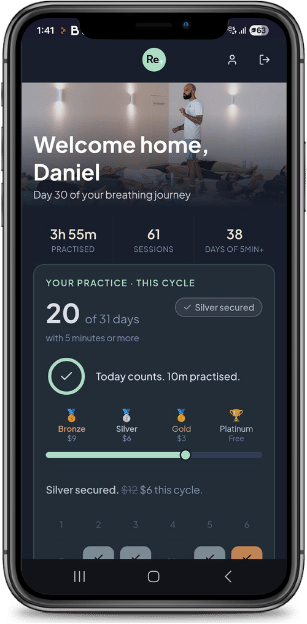
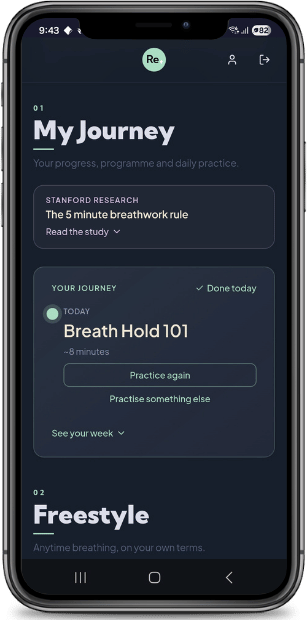
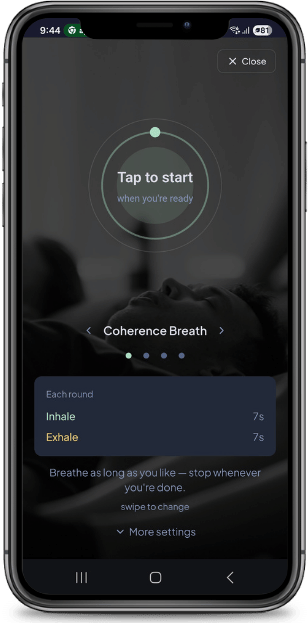
The experience is personalised because people do not all arrive with the same stress level, breathing habits or goals. My technology background taught me how important it is to keep a tool relevant to the person in front of it. Facilitating large rooms taught me that information alone is not enough. People also need an experience that creates a spark.
In the sessions, I help people understand how breathing can influence their nervous system, then give them a technique they can actually repeat. If you are new to the subject, start with what breathwork is. Employees can also use the free coherence breathing timer for a simple guided rhythm.
You can see how this combination fits together on our corporate breathwork page, or explore the Be Remindful app that supports daily practice between sessions.
None of this is a silver bullet. It works better because it is designed to live inside the culture, respects the reality of a business that needs to perform, and puts support where people can use it.
References
- Australian Bureau of Statistics. Two in five Australians have experienced a mental disorder. Media release, 5 October 2023. View source
- Australian Bureau of Statistics. National Study of Mental Health and Wellbeing, 2020 to 2022. View source
- Sonder. Understanding average EAP utilisation rates. View source
Frequently asked questions
Why do most corporate wellness programs fail?
They are often treated as a one off event rather than part of everyday culture. A wellness day or an unused EAP does not change the conditions people work in, so engagement fades and habits do not have time to form.
What is a typical EAP utilisation rate in Australia?
Published industry estimates commonly put average EAP utilisation at roughly 5 per cent, even though most large Australian companies offer one. The exact rate varies by provider, workforce and how utilisation is measured.
Does employee wellbeing improve business performance?
Research generally links better employee wellbeing with stronger attendance, engagement and performance. The relationship is complex, and results often build over time rather than appearing as an immediate return from one intervention.
What makes a workplace wellness initiative work?
Supportive leadership, practical tools people can use during the working day, regular reinforcement and permission to participate without stigma all improve the chance that an initiative becomes part of the culture.
Is corporate breathwork just another temporary fix?
It can be if it is delivered once and never revisited. When an introductory session is paired with an accessible daily practice, peer encouragement and regular facilitator contact, employees have a better chance of turning the technique into a useful habit.
About the author
Daniel Augustine
Daniel is the founder of Be Remindful, a Breathless Masters Instructor and an Oxygen Advantage Advanced Instructor. He has spent fifteen years across ad tech and mindfulness, runs breathwork sessions for teams at companies including Google, Atlassian, Salesforce and Spotify, and works one-on-one with people managing anxiety, stress and performance.
Want to try breathwork for yourself?
Sessions run for individuals, private groups and workplace teams, in Sydney, Melbourne, Brisbane, Gold Coast, Adelaide and online. No experience needed.