Techniques
How to Do Wim Hof Breathing (and How to Do It Safely)
A step by step guide to Wim Hof breathing: the full protocol, where it came from, what is actually happening in your body, and who should build a foundation first.
Wim Hof breathing is a cycle of around 30 big, fast breaths followed by a breath hold on empty lungs, repeated for three to five rounds. It is one of the most powerful things you can do with your breath, and it is not the right place for everyone to start. Below is the full protocol, what happens in your body while you do it, who should build a foundation first, and how to get something real out of it rather than just chasing the buzz.
For how it compares to other techniques and what the research says, see Wim Hof breathing versus other techniques. This page is the how-to.
What Wim Hof breathing is
At its simplest, it is a fast, full inhale followed by a passive exhale, done over and over with almost no pause between them, and then a long hold with the lungs empty.
The full Wim Hof Method is three things, not one: the breathing, cold exposure and a commitment or mindset piece, usually with some movement alongside. Most people meet it through the ice baths. The breathing is the part you can do anywhere, and it is the part that does the heavy lifting for how you feel.
The pattern is deliberately the opposite of most breathwork. Box breathing and 4-7-8 breathing ask you to slow down. This asks you to speed up, on purpose, in a controlled way, until your blood chemistry shifts.
Where it came from
Wim Hof is a Dutch athlete, known widely as The Iceman, who has done an enormous amount to bring breathwork into mainstream Western awareness. He built and systematised the method, took it into university laboratories and has set numerous records for feats of cold endurance over the years.
The lineage gets muddled a lot, though, so let me set it out properly.
Wim Hof breathing sits in the same family as tummo, sometimes written g-tummo, a Tibetan Buddhist practice whose name translates roughly as inner fire. Tummo is thousands of years old, forms part of the Six Dharmas of Naropa and is used by practitioners to generate heat and drop into deep meditative states, including in genuinely extreme cold.
There is a real family resemblance between the two, and it deserves acknowledging. But they are not the same technique. Tummo's core breath is vase breathing, a slow, deliberate retention paired with visualisation of a fire in the belly, and it sits inside a whole framework of channels and energy that has a spiritual aim, not a wellness one. Wim Hof breathing is cyclic fast breathing with no visualisation and no religious component. Hof's own organisation describes the two as comparable but different, and says his method came out of direct experimentation with cold rather than from a Buddhist lineage.
Credit where it is due to a very old tradition that got here first, without pretending one is a rebrand of the other.
Other names you will see for it
People search for this under a lot of different labels:
- Wim Hof Method, or WHM, which strictly means the whole system including cold and mindset.
- Tummo breathing, which is related but not identical.
- Power breathing, which is what the 30 fast breaths themselves are often called.
- Cyclic hyperventilation with retention, which is the term researchers tend to use. Hyperventilation means breathing faster or deeper than your body currently needs, and retention means the breath hold.
- Holotropic or conscious connected breathing are sometimes lumped in with it. They are genuinely different practices with a different rhythm and intention.
How to do Wim Hof breathing, step by step
Before anything else, lie down. Sit or lie somewhere safe and neutral, ideally lying, with loose clothing so your belly can move. Never do this in water, near water, in a bath, in a pool or while driving. Wim Hof's own guidance says the method can in rare cases cause you to lose consciousness. On a living room floor that is harmless. Anywhere near water it is not.
- Take around 30 big breaths. Inhale fully through the nose or mouth, and let the breath travel up through the belly, the ribs and into the chest. Then just let it go. The exhale is passive: you are not pushing the air out, you are releasing it and letting it fall. Do not fully empty the lungs.
- On the last breath, exhale and hold. After your final breath, let the exhale go and then stop. Hold with the lungs empty and let your body settle. Do not force it or brace. Stay still and let it be there.
- Hold until you feel the genuine urge to breathe. For most people this is far longer than they expect.
- Take a big breath in and hold it for 10 to 15 seconds. This is the recovery breath. Fill up, hold, then release with a sigh.
- That is one round. Go again. Three to five rounds is typical. Afterwards, do not jump straight up. Give yourself a few minutes lying there. A lot of the value is in what happens after the last round, not during.
What you might feel, and what is normal
Tingling in the hands and face is normal. Lightheadedness is normal. So is a curling or clawing of the hands and fingers, which has a name: tetany. It is a well-known effect of fast breathing, caused by a shift in your blood's acidity that temporarily changes how calcium behaves in your nerves and muscles. It is not tetanus, which is a bacterial infection and an entirely different thing.
Emotion coming up is also normal, and for some people it is the whole point.
What is actually happening in your body
When you take those 30 fast, full breaths, you are offloading a large amount of carbon dioxide. That has a few knock-on effects: your blood becomes more alkaline, blood vessels in the brain narrow, your nerves become more electrically excitable and adrenaline goes up. That is where much of the tingling comes from.
Then you hold, and CO2 starts climbing back up from a much lower starting point than usual.
One correction, because this appears everywhere including on some official material: you are not meaningfully increasing the oxygen in your blood. Your haemoglobin, the part of your blood that carries oxygen, is already around 98 percent loaded when you are sitting still. There is very little room left to fill. What actually changes is the CO2, and almost everything you feel during a session traces back to that, not to extra oxygen.
Why the long breath hold is not what you think
CO2, not oxygen, is what triggers your urge to breathe. When you have just offloaded a huge amount of it, your CO2 has to climb a long way back up before it trips that alarm. That is the entire reason you can hold your breath for two or three minutes after a round of Wim Hof when you might manage forty seconds cold.
You have not got better at holding your breath. You have temporarily emptied the tank that sets off the alarm.
Building actual breath-hold capacity works the other way around: you let CO2 build up in small, controlled doses and train your tolerance to it over time. That is what CO2 tolerance training is for. Wim Hof and CO2 tolerance work are almost opposite mechanisms pointed at different goals.
Why it feels so good
The hyperventilation phase causes a temporary drop in CO2, called hypocapnia, which constricts blood vessels in the brain and reduces cerebral blood flow. This is a documented physiological effect and a plausible part of why the mental noise quiets down after a round. It is worth being clear that this is an interpretation of established physiology, rather than something researchers have directly proven causes the sense of calm.
What the research does and does not support
The immune-response research is genuinely strong. The 2014 Radboud University study found that trained participants could blunt their own innate immune response after training in Wim Hof's combination of breathing, cold exposure and meditation.
But the euphoric, cathartic feeling Wim Hof produces, while real and valuable in the moment, is not yet backed by strong evidence for lasting downstream benefits like long-term stress reduction or mental health improvement. Some small studies have shown promising results, while at least one larger controlled trial found no significant change in stress or mood measures. Do not oversell it as proven for things it is not proven for yet.
By contrast, CO2 tolerance and slow breathing techniques have more consistent longer-term evidence behind them. A systematic review of slow breathing found reasonably consistent effects on heart rate variability, parasympathetic activity and self-reported relaxation, none of which depend on hyperventilating first.
Who should hold off on Wim Hof breathing
If you have any of the following, this is not a starting point and you should speak to a doctor first:
- Pregnancy.
- Epilepsy or any seizure history.
- Cardiovascular conditions, including high blood pressure that is not well controlled.
- A history of psychosis, or a psychiatric condition where intense altered states could be destabilising.
- Any history of fainting or blackouts.
Regardless of who you are, never practise in or near water, and never while driving or doing anything that needs motor control. This is the safety rule that has actually prevented serious harm.
If you run anxious or breathe shallowly and up in the chest, Wim Hof can make things worse. Breathing fast on top of an already fast, shallow, chest-based pattern is not a reset. It can tip straight into panic and reinforce exactly the habit you are trying to move away from. Our guide to diaphragmatic breathing is a steadier place to begin, and breathwork for anxiety covers gentler options.
Getting more out of it than the buzz
Wim Hof is a genuinely great tool. It is not a silver bullet, and there are plenty of people who have practised it for years and are still struggling. Feeling euphoric for twenty minutes is not the same as changing anything.
What makes the difference, in my experience, is intention. Before you start, ask yourself:
- What am I doing this for today?
- What is actually coming up for me right now?
Afterwards, while you are still lying there, notice what surfaced. Self-awareness is what carries over into the rest of your life. The euphoria does not.
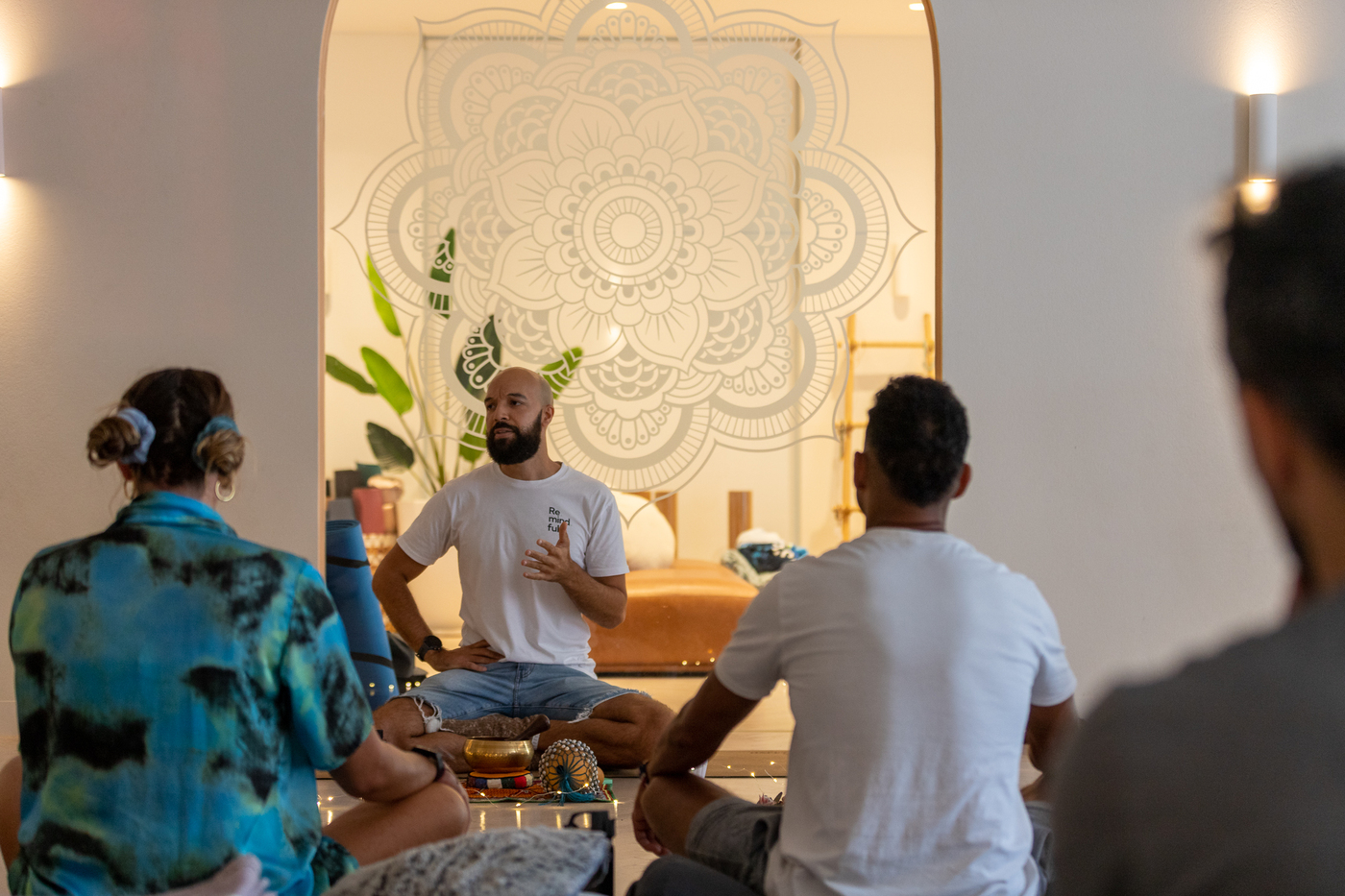
This is a powerful practice and it is much better done with a guide present, particularly your first few times. If that is not available to you, the Wim Hof app or a guided session is a reasonable substitute and much better than freestyling it alone with a stopwatch. If you are in Sydney, we run sessions where this is one of the things we work with.
Related reading
If your goal is to settle down for the night rather than create an intense shift, use 4-7-8 breathing or read the full day routine in breathing for better sleep.
References
- Wim Hof Method, official breathing technique guidance. View source
- Wim Hof Method on tummo meditation and how it differs. View source
- Kox, M., et al. (2014). Voluntary activation of the sympathetic nervous system and attenuation of the innate immune response in humans. PNAS, 111(20), 7379-7384. View source
- Zaccaro, A., Piarulli, A., Laurino, M., et al. (2018). How Breath-Control Can Change Your Life: A Systematic Review on Psycho-Physiological Correlates of Slow Breathing. Frontiers in Human Neuroscience, 12, 353. View source
- Leacy, J. K., Day, T. A. and O'Halloran, K. D. Isolating the independent effects of hypoxia and hyperventilation-induced hypocapnia on cerebral haemodynamics and cognitive function. View source
This article is for general information and is not medical advice. If you have a health condition, speak to your doctor before starting any intense breathing practice.
Frequently asked questions
How many breaths are in a Wim Hof breathing round?
Around 30 is a common starting point. Some teachers begin with 20 and official guidance can go up to 40 as you gain experience. The quality and comfort of the breath matter more than hitting a number.
How many rounds of Wim Hof breathing should I do?
Three to five rounds is typical. Start with three, stay within a comfortable effort and give yourself a few minutes to rest afterwards.
Is Wim Hof breathing safe?
For many healthy adults it can be practised safely while seated or lying down on dry land, without forcing the holds. It is not safe in or near water, while driving or for everyone with a health condition. Check with a doctor if you are pregnant or have epilepsy, a cardiovascular condition or a history of fainting.
Why do my hands cramp during Wim Hof breathing?
Fast breathing can temporarily shift your blood acidity and change how calcium behaves in your nerves and muscles. This can cause tingling or a curling of the hands called tetany. Slow down or stop if it feels distressing.
Does Wim Hof breathing improve breath-hold capacity?
Not in a lasting way. The fast breathing lowers CO2, which delays the urge to breathe during the following hold. CO2 tolerance training is the better fit for building lasting tolerance.
Should I do Wim Hof breathing before bed?
Generally no. It can be energising and raise adrenaline. Use slower practices such as 4-7-8 breathing when your goal is to wind down for sleep.
About the author
Daniel Augustine
Daniel is the founder of Be Remindful, a Breathless Masters Instructor and an Oxygen Advantage Advanced Instructor. He has spent fifteen years across ad tech and mindfulness, runs breathwork sessions for teams at companies including Google, Atlassian, Salesforce and Spotify, and works one-on-one with people managing anxiety, stress and performance.
Want to try breathwork for yourself?
Sessions run for individuals, private groups and workplace teams, in Sydney, Melbourne, Brisbane, Gold Coast, Adelaide and online. No experience needed.