Techniques
Deep Breathing: How Diaphragmatic Breathing and Belly Breathing Work
A practical guide to deep breathing, diaphragmatic breathing and belly breathing: improve posture, expand your ribs in all directions and get out of your chest.

"I really struggle to take a deep breath. It always seems to land in my chest."
This is the single most common thing people say to me in classes. Diaphragmatic breathing, often called belly breathing, is one way of practising deep breathing. The instinctive fix, trying harder to force the breath down into your belly, almost never works.
There are many possible reasons a breath can feel restricted. But if this is a familiar pattern rather than new or worsening breathlessness, positioning is one practical contributor worth checking. If posture is closing down the space your diaphragm needs to move through, forcing a bigger breath is unlikely to help. So before we touch the breath itself, we sort out the shape you are breathing in.
Your diaphragm needs room to move
Your diaphragm is a large dome-shaped muscle sitting just under your lungs. Breathe in and it contracts and pulls down, drawing air into the lower parts of your lungs. Breathe out and it moves back up.
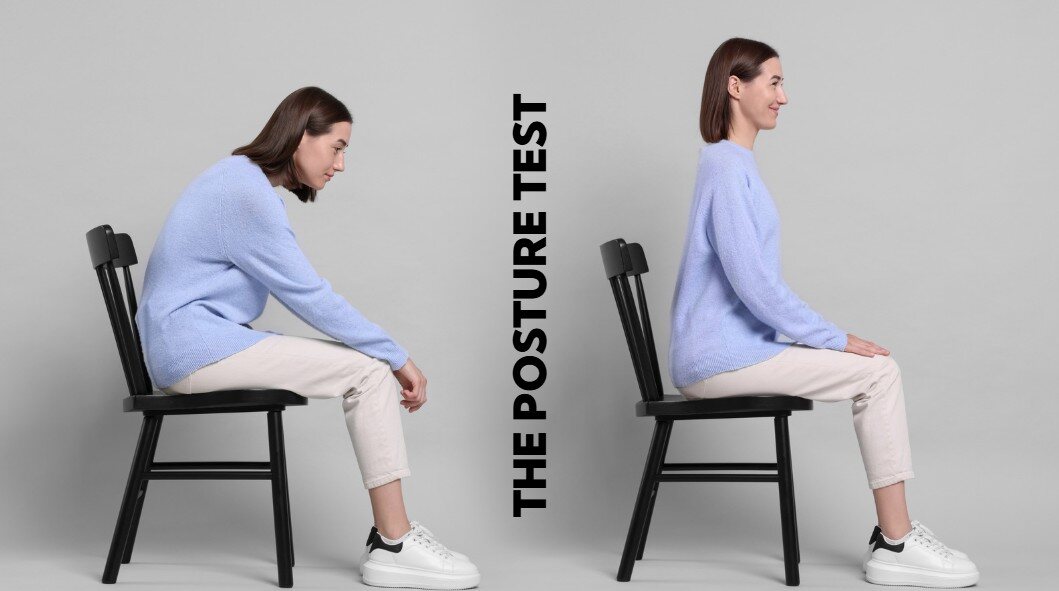
A useful way to picture it: think of the movement as a piston travelling up and down inside a cylinder. When you arch your back hard, stick your backside out, flare your ribs, or hunch forward, you effectively put a kink in that cylinder. The piston cannot travel properly. That is what a chest-only breath feels like from the inside.
This is not just a nice image, it shows up when you measure it. Researchers tested 35 healthy young men sitting upright and then slouched, and measured how strongly their breathing muscles could pull. Slouched was significantly weaker. They put that down to the diaphragm simply having less room to move.
A second study found the same pattern and also measured how far the ribcage expanded on each breath. Slouched, it expanded less.
So: check the posture first. It will not explain every case of a restricted breath, but it is a useful place to experiment before trying harder to inhale.
Feel the difference for yourself
The fastest way to understand this is to experience both ends of it.
Step 1. Feel it restricted. Arch your back to its full extent. Flare your chest out, look up, and try to take a deep breath into your belly. Notice how restricted it is, and how hard the breath is to get low.
Step 2. Feel it open. Now tuck your tailbone in slightly, draw your flared ribs down and in, and bring yourself up straight. Breathe in deeply from here and feel the difference.
The rib cue is the one people find hardest, so here is how I describe it (not scientific, but it lands): imagine a boxer is coming at you with a hook aimed at your ribs. The way you would dodge that punch by drawing your ribs in slightly is the position you are looking for.
The important part: you are still standing up straight. Tucked tailbone, ribs down, spine tall. And once you have found that shape, relax into it rather than holding yourself rigid there. Stiffness is its own kind of restriction.
Breathing 360 degrees
Once the position is sorted, this is how to find the breath itself.
Place your right hand on your lower right rib cage and your left hand on your lower left rib cage, thumbs tucked around toward your back so you are holding your whole waistline, front and back.
Now breathe into that space. Not just forward into your hands. Try to feel expansion out to the sides, and almost as though you are breathing out through your back as well. That is what people mean by 360-degree breathing, and your hands give you the feedback to know whether it is actually happening.
If you are lying down
Lying on the floor makes this easier for a lot of people, with two adjustments:
Bend your knees, feet flat on the floor. This lets you find the position without having to hold it with effort.
Check the gap in your lower back. If you can slide your hand under your lower back easily, you likely have more of an arch than you want. Tilt your pelvis so you are gently pressing down into your hand, almost squashing it. You are aiming for as much contact between your back and the floor as is comfortable.
If your nose is clear, use a gentle nasal inhale while you practise. Our guide to nose versus mouth breathing explains why that is often a useful default, and when using the mouth is more practical.
What to actually practise
Once you have got the position and you can feel the 360 expansion:
- Breathe in deeply for 5 seconds, out slowly for 5 seconds. That is the foundation.
- Add a hold at the top if you like. Staying in the expansion for a moment helps reinforce it.
- Try box breathing here. It is a good fit, because the hold at the top works the diaphragm in that expanded position, and the hold at the bottom of the exhale builds your tolerance to CO2.
One thing worth understanding: light, slow and deep are not in conflict. You can breathe gently, at a slow pace, and still be breathing deeply into the lower lungs. Deep does not mean big and forceful. In fact, the more controlled and quiet your breath is while still reaching the bottom of your lungs, the better the practice is working.
Why shallow breathing becomes a habit
Most of us did not choose shallow breathing. Long hours seated, hunched over screens, and a fast-paced always-on environment all tend to push us into the postures and the alertness that produce it. Shallow, upper-chest breathing is fundamentally what the body does when it is braced for action.
There is also a loop here worth understanding, because it explains why the habit sticks.
CO2 is what tells you to take your next breath. As it builds up, it trips an internal alarm and you breathe. Simple enough. But if your everyday breathing is quick and shallow, you are clearing CO2 faster than you need to, and your body gradually gets used to running on less of it. The alarm then starts going off earlier. So you breathe faster again, which keeps CO2 low, which keeps the alarm sensitive. Round and round.
Doctors do recognise a version of this in people who chronically overbreathe, where the body settles at a permanently low CO2 level, and there is research underway into whether that level can be nudged back up.
Worth being straight with you: this is the model breath retraining works from rather than something proven start to finish in healthy people. But it is why diaphragmatic breathing and CO2 tolerance training are usually taught side by side. The fuller, slower breath and the better CO2 tolerance feed each other.
If shallow breathing is also tied to anxiety for you, the article on breathwork for anxiety covers how the nervous system connects to breathing patterns and what to do about it.
References
- Albarrati, A., et al. (2018). Effect of Upright and Slouched Sitting Postures on the Respiratory Muscle Strength in Healthy Young Males. BioMed Research International, 2018:3058970. View source
- Effect of Upright and Slouched Postures on the Diaphragm Strength and Chest Expansion in Obese Young Adults. Indian Journal of Physical Therapy and Research, 2022. View source
- Normalizing CO2 in Chronic Hyperventilation by a Novel Breathing Mask: A Pilot Study. University of Aarhus. ClinicalTrials.gov NCT01575665. View source
Frequently asked questions
Why can't I take a deep breath into my belly?
A familiar chest-based breathing pattern can be affected by posture. An arched back, flared ribs, or a hunched position may reduce how freely the diaphragm and ribs move, so it is worth experimenting with a more comfortable position. New, worsening or persistent breathlessness needs medical assessment.
What is diaphragmatic breathing?
Breathing that uses the diaphragm, the large muscle under your lungs, to draw air into the lower parts of the lungs, rather than relying on the upper chest and shoulders.
What is 360 breathing?
Breathing that expands the ribcage in all directions, front, sides and back, rather than only forward into the belly. Holding your lower ribs with both hands is the easiest way to feel whether it is happening.
Does posture really affect breathing?
Yes. Studies comparing upright and slouched sitting found that breathing muscles were measurably weaker when slouched, and the ribcage expanded less on each breath.
Can breathing be deep and gentle at the same time?
Yes, and that is the goal. Deep refers to where the air goes, not how forcefully you pull it in. Light, slow and deep can all be true at once.
About the author
Daniel Augustine
Daniel is the founder of Be Remindful, a Breathless Masters Instructor and an Oxygen Advantage Advanced Instructor. He has spent fifteen years across ad tech and mindfulness, runs breathwork sessions for teams at companies including Google, Atlassian, Salesforce and Spotify, and works one-on-one with people managing anxiety, stress and performance.
Want to try breathwork for yourself?
Sessions run for individuals, private groups and workplace teams, in Sydney, Melbourne, Brisbane, Gold Coast, Adelaide and online. No experience needed.