Science
CO2 Tolerance Training: What It Is and How to Build It Safely
CO2 tolerance training explained: why the urge to breathe is not about oxygen, how to test your BOLT score, and a safe exhale-based protocol for building it.

Most people assume the urge to breathe is a signal that they are running low on oxygen. It is not. The gas that actually triggers that urge is carbon dioxide, and how you respond to it turns out to shape a great deal about how you breathe under pressure.
CO2 tolerance training is a set of breathing exercises that train your body to be less reactive to rising carbon dioxide. Better tolerance tends to show up as calmer, slower, more efficient breathing, and as a reduced sensitivity to the uncomfortable feeling of air hunger that drives anxious, shallow breathing patterns.
Here we walk through why CO2 is the real driver, how to get a sense of your current tolerance, why functional breathing work is done differently from a freediving protocol, what the research genuinely supports, and a safe way to begin.
Why CO2, not oxygen, is the real driver
It feels intuitive to think the urge to breathe is your body running low on oxygen. It is not. Chemoreceptors in your brainstem and blood vessels are far more sensitive to rising CO2 than to falling oxygen, and it is the CO2 signal that triggers the urge to breathe. Some people are naturally more sensitive to this signal than others, and that sensitivity can be trained down over time. That is the entire premise of CO2 tolerance work.
This matters because a lot of dysfunctional breathing (over-breathing, chest breathing, a racing breath rate under stress) comes from an oversensitive CO2 response, not from an actual lack of air. If you are struggling to get out of the chest and into a calmer lower-rib breath, our guide to diaphragmatic breathing gives the physical setup. If you are new to the wider topic, our guide to what breathwork is sets out the foundations before you go further.
How to test your CO2 tolerance (the BOLT score)
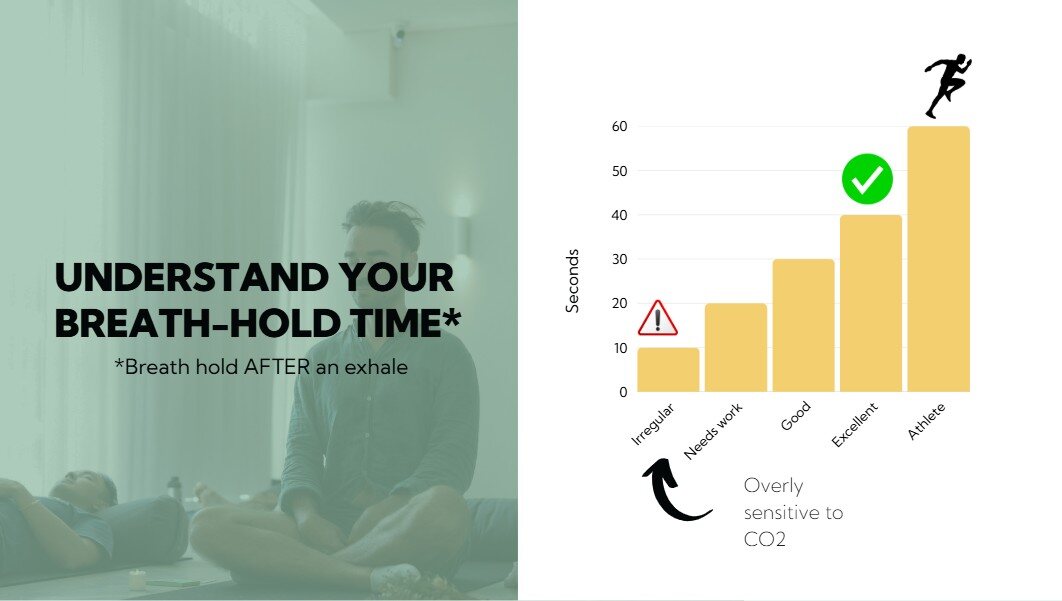
A simple way to get a sense of your current tolerance is the Body Oxygen Level Test (BOLT), developed by breathing educator Patrick McKeown. The idea: after a normal, relaxed exhale (not a big breath), gently pinch your nose and time how long it takes before you feel the first real urge to breathe. That means the first genuine signal, not your maximum. Release and return to normal breathing immediately. You should not be gasping afterward.
This is not a competition and it is not a maximal breath-hold test. If you finish gasping for air, you held too long, so ease off next time. The number itself matters less than the trend: as your tolerance improves over weeks of practice, that first-urge time tends to increase. Measuring or tracking a BOLT score is easier when something keeps the record for you, and the Be Remindful app scores your CO2 tolerance so you can watch the trend rather than a single reading.
Why this training is done on the exhale, not a full inhale
If you have spent time in freediving circles, you may have heard “CO2 table” used to describe something different: a structured set of breath holds done on a full inhale, with the rest interval between holds shrinking each round so CO2 builds up progressively across the session. That is a legitimate protocol, but it is built for a different goal, which is extending maximum static breath-hold time for diving.
Functional breathing work (the BOLT test and the CO2 tolerance exercises built around it) is deliberately done on a normal exhale, not full lungs. Holding on emptier lungs means you reach the CO2 signal faster and with a smaller, more controllable air reserve, which makes it easier to train the response in short, manageable doses rather than needing long, maximal holds. The underlying principle is the same, which is building tolerance to rising CO2. Only the convention differs, depending on which discipline you are in.
What the research actually supports
This is a case where it is worth being precise about what is proven versus assumed, because the claims that circulate about CO2 tolerance training are often broader than the evidence.
Well-supported: CO2 tolerance is directly linked to how reactive your nervous system is to breathing-related sensations. Research on panic disorder shows that people with the condition tend to have a heightened, oversensitive response to rising CO2, sometimes called a “false suffocation alarm,” and that changes in blood CO2 levels during breathing retraining are directly linked to reduced anxiety sensitivity in treatment studies. Separately, research comparing trained breath-hold divers to the general population found freedivers have measurably reduced CO2 sensitivity from repeated breath-hold training, in contrast to the heightened sensitivity seen in panic disorder. One caveat worth stating plainly: that evidence establishes the relationship between CO2 sensitivity and anxiety, and it comes from clinical breathing retraining and from freedivers. It is not a trial of the specific protocol below, which is a practical application of the principle rather than a tested intervention in its own right.
More assumed than proven: the idea that CO2 tolerance training straightforwardly lowers your day-to-day stress levels. The honest, defensible claim is narrower: training reduces your reactivity to air hunger and breathing-related sensations specifically. That is a meaningfully different (and better-supported) claim than “this will make you less stressed in general,” even though the two get blurred together in a lot of wellness content.
A simple, safe way to start
Short breath holds are where CO2 tolerance training comes up most naturally, and if the idea of holding your breath at all feels daunting, the gentlest way in is box breathing, which builds comfort with brief, equal holds before you ever measure a thing.
- Sit comfortably and take a few normal, relaxed breaths through your nose.
- After a normal exhale, gently pinch your nose and hold.
- Hold only until the first clear urge to breathe, not your limit.
- Release and breathe normally through your nose. If you are gasping, ease off next time.
- Rest for a full minute of normal breathing before repeating.
- Start with just a handful of rounds. Progress gradually over weeks, not days.
It is worth noting how different this is from techniques that deliberately offload CO2. A comparison of Wim Hof breathing and other techniques shows the contrast clearly: rounds of hyperventilation blow off CO2 to enable a longer hold, whereas CO2 tolerance work does the opposite by letting CO2 build so you learn to sit with the signal.
Safety notes
CO2 tolerance work is generally safe for healthy adults when built up gradually. If you have a cardiovascular or respiratory condition, are pregnant, or have a diagnosed panic or anxiety disorder, check with a doctor first. Deliberately inducing air hunger sensations can be counterproductive without the right guidance and pacing for these situations. If anxiety sensitivity is your main concern, our guide to breathwork for anxiety covers gentler approaches that do not lean on air hunger. Never do breath-hold training in or near water, and never push to the point of gasping or dizziness.
If you would like guidance on building CO2 tolerance safely, we run private one-on-one sessions and group sessions, and the Be Remindful app tracks your CO2 tolerance so you can follow the trend over time rather than chasing a single number.
References
- Meuret, A. E., et al. Respiratory and Cognitive Mediators of Treatment Change in Panic Disorder. PMC. View source
- The implications of the diving response in altering carbon dioxide sensitivity in panic disorder patients. Frontiers in Psychiatry, 2025. View source
- Breath-hold time and anxiety-related vulnerability: A systematic review and meta-analysis. ScienceDirect. View source
Frequently asked questions
What is CO2 tolerance training?
Breathing exercises, typically built around short breath holds, that train your body to be less reactive to rising CO2, the gas that actually drives your urge to breathe.
What is a good BOLT score?
The number itself matters less than the trend over time. The goal of tracking it is to see gradual improvement with consistent practice, not to hit a specific target quickly.
Is CO2 tolerance training the same as a freediving CO2 table?
No. Freediving CO2 tables are done on a full inhale with shrinking rest intervals, built for extending dive time. Functional breathing CO2 tolerance work, like the BOLT test, is done on a normal exhale. Same underlying principle, different protocol.
Does CO2 tolerance training reduce stress?
The well-supported claim is narrower: it reduces reactivity to air hunger and breathing-related sensations. Evidence for a broader, general stress-reduction effect is weaker than that specific claim.
Is it safe for anxiety or panic disorder?
It can be part of breathing retraining, but people with a diagnosed panic or anxiety disorder should approach breath-hold work gradually and ideally with professional guidance, since it involves deliberately experiencing air hunger sensations.
About the author
Daniel Augustine
Daniel is the founder of Be Remindful, a Breathless Masters Instructor and an Oxygen Advantage Advanced Instructor. He has spent fifteen years across ad tech and mindfulness, runs breathwork sessions for teams at companies including Google, Atlassian, Salesforce and Spotify, and works one-on-one with people managing anxiety, stress and performance.
Want to try breathwork for yourself?
Sessions run for individuals, private groups and workplace teams, in Sydney, Melbourne, Brisbane, Gold Coast, Adelaide and online. No experience needed.