Breathwork
Breathwork vs Meditation: Which Is Right for You?
Breathwork vs meditation: what is the difference, and which should you try? An honest comparison of how each one works, who it suits, and how to use both.
It is one of the most common questions we hear: what is the difference between breathwork and meditation, and which one should I be doing?
The honest answer is that they are different tools with different strengths, and the right choice depends on what you are trying to achieve. They are also not mutually exclusive. Plenty of people practise both.
We teach breathwork at Remindful, so it is worth saying plainly: we are not here to tell you meditation is inferior. It isn’t. This is a straight comparison to help you pick the practice that fits your goals, your temperament and the amount of time you actually have.
What is breathwork?
Breathwork is the practice of using deliberate, controlled breathing patterns to create specific changes in your physical and emotional state. It is an active practice. You are consciously directing your breath through particular rhythms, depths and holds in order to influence your nervous system.
Techniques range from gentle to intense. At the gentle end sit box breathing and 4-7-8 breathing. At the intense end sit holotropic breathwork and the Wim Hof Method. The common thread across all of them is intentional control of the breath.
What is meditation?
Meditation is the practice of training attention and awareness, usually to reach mental clarity, emotional calm or spiritual insight. Most styles involve observing thoughts without attaching to them, focusing on a single point such as a mantra or the breath, or cultivating a specific quality such as compassion.
Common forms include mindfulness meditation, transcendental meditation, loving-kindness meditation, body scan meditation and yoga nidra.
The five key differences
1. Active versus passive
This is the most fundamental difference. Breathwork is active: you are doing something specific with your body. You are counting, holding, changing rhythm. Your mind has a concrete task.
Meditation is generally passive. You are observing, allowing, practising non-doing, letting thoughts pass without engaging them.
That distinction matters enormously if you have anxiety or racing thoughts. A lot of people find meditation frustrating, because sitting still with your thoughts is close to impossible when those thoughts are anxious ones. Breathwork gives the mind something physical to hold onto, which is exactly why it tends to be more accessible for beginners.
2. Speed of results
Breathwork produces faster, more tangible results. Most people feel noticeably different after their first session: calmer, more relaxed, sometimes energised, sometimes emotionally moved. That happens because breathwork changes your physiology directly — heart rate, blood chemistry, nervous system activation.
Meditation’s benefits tend to accumulate. The research on it is genuinely strong, but most of those benefits emerge after weeks or months of regular practice. Early sessions can feel like you are doing nothing, or doing it wrong.
3. Physiological versus psychological mechanism
Breathwork works primarily through direct physiological mechanisms. Changing your breathing pattern stimulates the vagus nerve, alters the CO2 and O2 balance in your blood, shifts your nervous system state and changes your brain wave patterns. It works bottom-up, from body to mind.
Meditation works primarily through psychological mechanisms. It trains attention, interrupts rumination, cultivates non-reactivity and develops meta-awareness - awareness of your own thinking. It works top-down, from mind to body.
4. Ease of entry
Breathwork has a lower barrier for most people. Follow a pattern, count your breaths, feel the result. There is very little ambiguity about whether you are doing it right.
Meditation can feel daunting at the start. “Observe your thoughts without judgement” is simple in theory and genuinely difficult in practice. Many people give up believing they cannot meditate, when in fact they just needed more time or a better entry point.
5. What a session actually feels like
Breathwork sessions are often visceral and emotionally intense. Depending on the technique you might experience tingling, temperature changes, emotional release or altered states of awareness. It feels like something is happening.
Meditation sessions are typically subtler. The goal is stillness, clarity and a quiet mind. The experience deepens gradually over months and years, through small shifts in how you relate to your own thoughts.
Breathwork vs meditation, side by side
| Dimension | Breathwork | Meditation |
|---|---|---|
| How you practise | Active and structured. You count, hold and change rhythm. | Observational and still. You notice and allow. |
| Time to feel a shift | Usually immediate - most people feel it in the first session. | Cumulative - benefits build over weeks of practice. |
| Main mechanism | Bottom-up. Works through the body and nervous system first. | Top-down. Works through attention and awareness first. |
| Easiest entry point for | Anxious, restless or sceptical beginners. | People already drawn to stillness and contemplation. |
| What a session feels like | Visceral. Tingling, warmth, emotional release. | Subtle. Quiet, spacious, gradually deepening. |
When breathwork is the better starting point
Breathwork is probably the right place to begin if:
- you have tried meditation and found it frustrating, or felt you simply could not do it
- you experience anxiety or stress and want relief in the moment
- you are short on time and want something that works in under five minutes
- you are a physical or kinaesthetic learner who would rather do than observe
- you want to feel a tangible shift in your very first session
- you are processing intense emotion, grief or stress that is being held in your body
- you are an athlete or high performer looking for a pre-performance protocol
When meditation is the better fit
Meditation may suit you better if:
- you want to build long-term equanimity and emotional resilience over months and years
- you are trying to improve sustained focus and attention
- you are drawn to a spiritual or contemplative practice
- you already enjoy silence and stillness and want to deepen that capacity
- you have an existing yoga practice you want to complement
- you want to cultivate specific qualities such as compassion, acceptance or non-reactivity
Using breathwork and meditation together
Here is what we have found works for a lot of our clients: stop treating this as a choice. Breathwork and meditation are complementary, and each makes the other easier.
The breathwork-first approach
Start with three to five minutes of breathwork - box breathing or extended exhale breathing - to settle your nervous system and quieten the mental chatter. Then move into five to ten minutes of silent meditation. You will usually find the meditation far easier, because your body is already calm and your attention is already gathered.
This is particularly effective for people who have struggled with meditation on its own. Breathwork acts as an on-ramp, turning stillness from something frustrating into something available.
A daily and weekly structure
Another approach is to practise short breathwork techniques daily - two to five minutes for immediate nervous system regulation - and do longer meditation sessions two or three times a week for deeper attention training.
What the research says
Both practices have substantial evidence behind them, but the evidence points at different strengths.
Breathwork
- A 2023 Stanford study found that five minutes of daily cyclic sighing was more effective at reducing stress and improving mood than five minutes of mindfulness meditation.
- Slow breathing techniques significantly improve heart rate variability, a key marker of stress resilience and cardiovascular health.
- Multiple studies confirm that controlled breathing produces immediate reductions in cortisol and blood pressure.
Meditation
- Long-term meditation has been shown to physically change brain structure, increasing grey matter density in regions associated with self-awareness, compassion and introspection.
- Mindfulness-Based Stress Reduction programmes show significant reductions in anxiety, depression and chronic pain across hundreds of clinical studies.
- Regular meditation improves sustained attention and reduces mind-wandering, with measurable effects after about eight weeks.
The takeaway: both work. Breathwork produces faster physiological change. Meditation produces deeper psychological and structural change over time.
Five myths worth clearing up
“I can’t meditate because I can’t clear my mind”
Meditation is not about clearing your mind. It is about noticing your thoughts and gently returning your attention. That returning is the practice. If your mind wanders, you are not failing at it - you are doing it.
“Breathwork is just fancy breathing”
In the same way that weightlifting is just picking things up. Specific breathing patterns create measurable, well-documented changes in your nervous system, your blood chemistry and your brain state.
“Meditation is religious”
Meditation has roots in Buddhist and Hindu traditions, but modern mindfulness meditation is entirely secular. The version taught in hospitals, schools and workplaces has no religious component at all.
“Breathwork is dangerous”
Gentle techniques - box breathing, 4-7-8, extended exhale - are safe for virtually everyone. More intense styles should be done with a qualified facilitator, particularly if you have a cardiovascular condition. We cover this in more detail in our FAQs.
“You have to choose one”
You don’t. Many people practise both, and using breathwork as an on-ramp to meditation is one of the most effective approaches we have seen.
How to get started
If you want to try breathwork
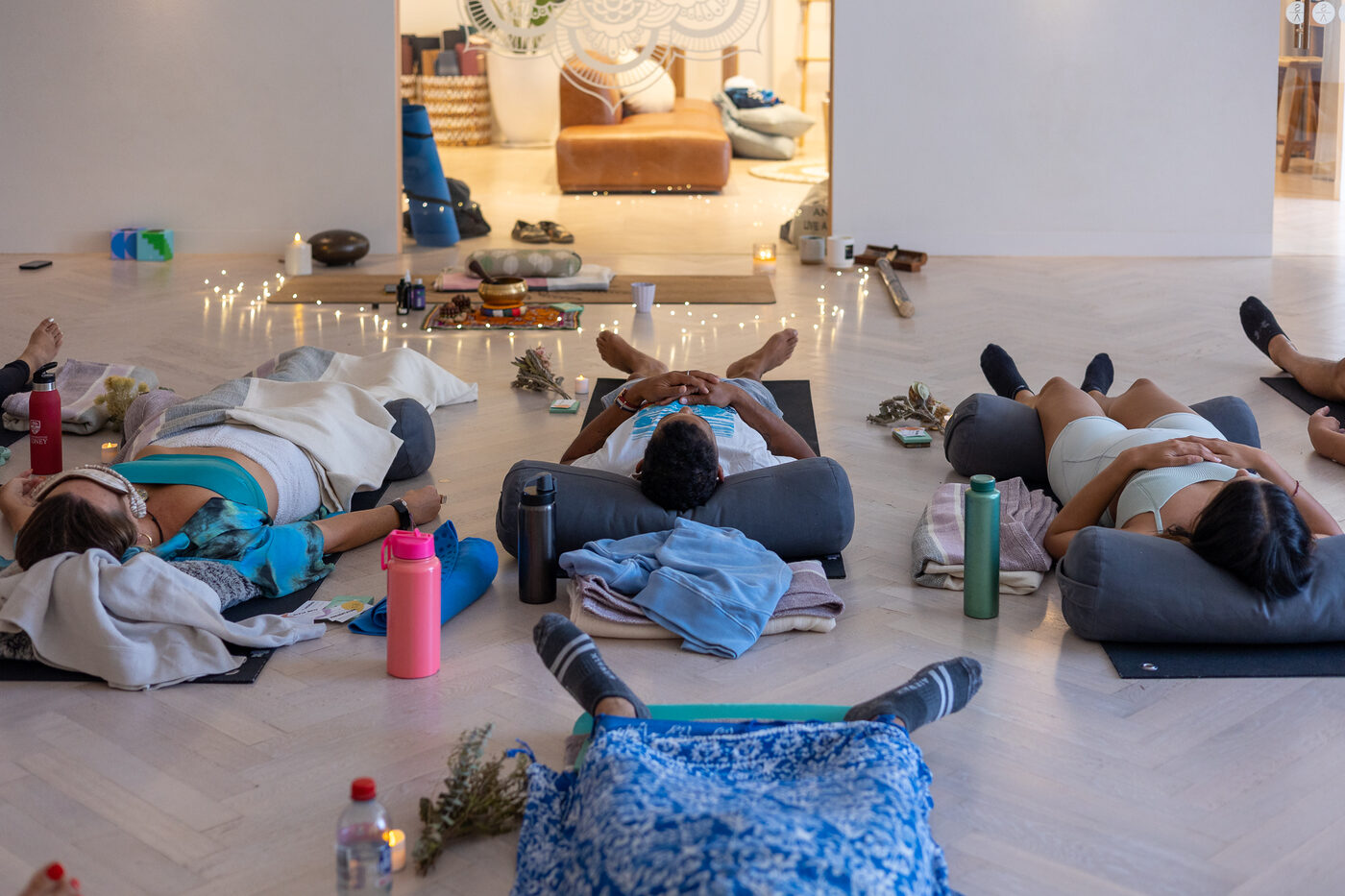
Start with box breathing or extended exhale breathing. Five minutes is genuinely all you need. If you would rather be guided through it, we run group breathwork sessions and private sessions, and there is a five-minute daily practice in the app.
If you want to try meditation
Begin with a guided app such as Headspace, Calm or Insight Timer, and start at five to ten minutes. Try not to judge yourself while you do it. If your mind wanders constantly at the beginning, that is completely normal.
If you want to try both
Do three minutes of box breathing, then sit for five minutes with your eyes closed and simply pay attention. Notice how much easier the stillness is once the breathing has done its work. That is the whole argument for combining them, and you can test it yourself this afternoon.
Frequently asked questions
Is breathwork a form of meditation?
Not exactly. There is real overlap, because both involve awareness and intention, but they are different practices. Breathwork is active control of your breathing pattern. Meditation is the training of attention and awareness. Some practices, such as mindful breathing, sit at the intersection of the two.
Can I do breathwork and meditation in the same session?
Yes, and we recommend it. Start with three to five minutes of breathwork to settle your nervous system, then move into meditation. The breathwork acts as an on-ramp, which makes the stillness considerably more accessible.
Which is better for anxiety, breathwork or meditation?
For immediate relief in the moment, breathwork is generally more effective, because it directly shifts your nervous system state within minutes. For long-term anxiety management, a combination of both is ideal.
I tried meditation and hated it. Should I try breathwork?
Yes. Many people who struggle with meditation find breathwork far more accessible, because it is active and produces immediate, tangible results. Counting and rhythm give your mind a concrete job instead of asking it to think about nothing.
How long before I notice any benefit?
With breathwork, most people notice something in their very first session. With meditation, research shows measurable changes after around eight weeks of consistent practice. Both improve with consistency.
About the author
Daniel Augustine
Daniel is the founder of Be Remindful and has spent fifteen years across ad tech and mindfulness. He runs breathwork sessions for teams at companies including Google, Atlassian, Salesforce and Spotify, and works one-on-one with people managing anxiety, stress and performance.
Want to try breathwork for yourself?
Sessions run for individuals, private groups and workplace teams — in Sydney, Melbourne, Brisbane and online. No experience needed.