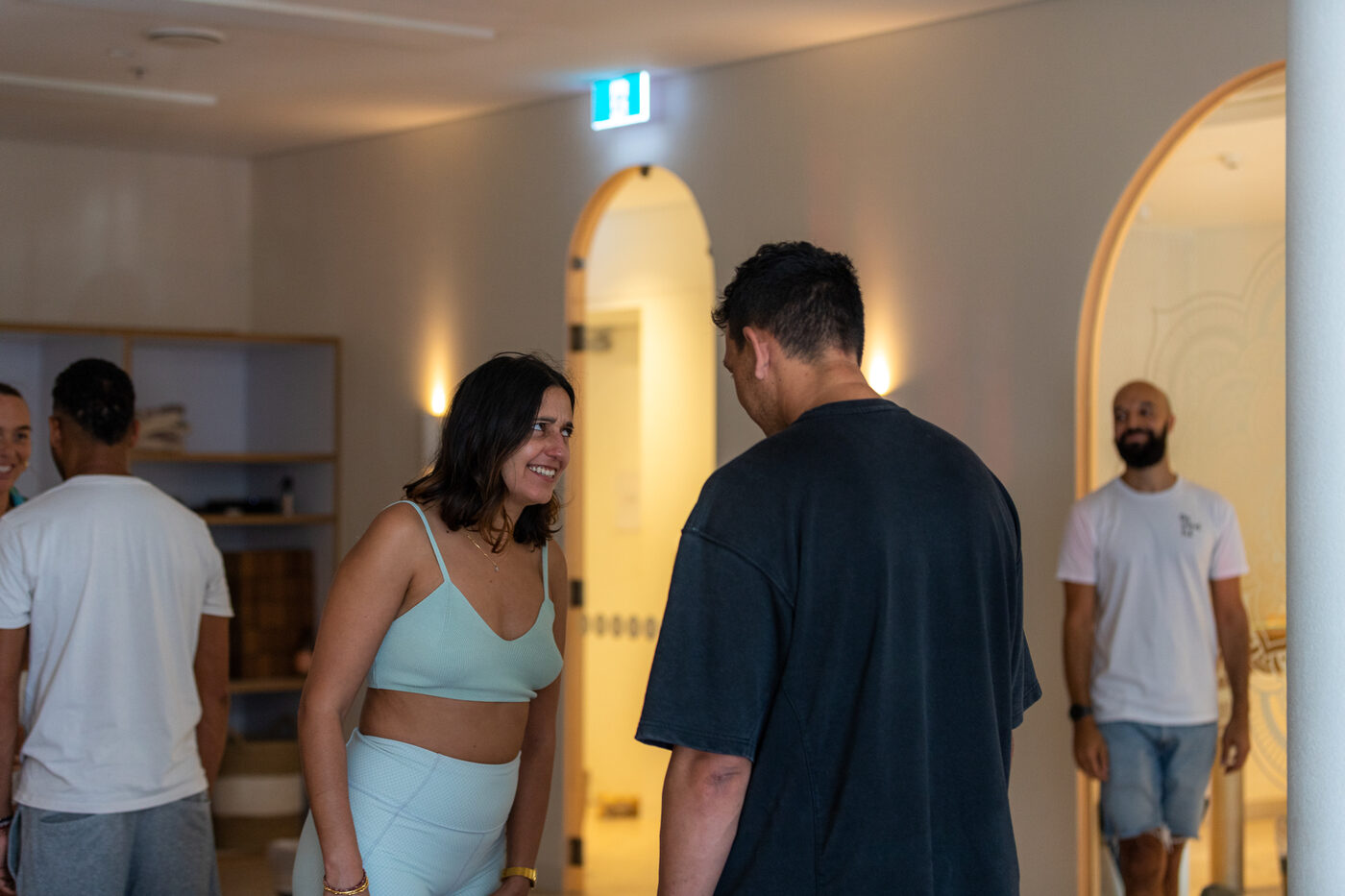
Close up of participant breathing
PartnershipsEvidence

What the breathing research shows

The studies, named and linked, so you can assess them yourself. Plus the questions the field is actively working on, because this area is opening up quickly.

The short version

Breathing practice has a real and growing evidence base. Meta-analyses show lower self-reported stress, anxiety and low mood. A Stanford trial found that five minutes a day for a month improved mood and lowered resting respiratory rate. On the airway side, a Cochrane review found that myofunctional therapy probably reduces daytime sleepiness and may improve sleep quality.

Prepared by Daniel Augustine, Breathless Masters Instructor and Oxygen Advantage Advanced Instructor. View LinkedIn profile

Slow breathing and stress

Breathing practice reduces stress, anxiety and low mood

Fincham and colleagues, in Scientific Reports in 2023, pooled 12 randomised controlled trials involving 785 adults. Breathwork significantly reduced self-reported stress against control conditions, with a small to medium effect size. Across 20 trials, anxiety moved the same way. Across 18 trials, depressive symptoms moved the same way. Both findings were statistically significant.

This is not a single small experiment. It is a synthesis of controlled studies across different breathwork protocols and adult populations. The effect sizes are not dramatic, but the direction is clear enough to make breathing practice a sensible low-cost complement to the work clinicians already do.

Fincham GW, Strauss C, Montero-Marín J, Cavanagh K. Effect of breathwork on stress and mental health: a meta-analysis of randomised-controlled trials. Scientific Reports. 2023;13:432.

https://www.nature.com/articles/s41598-022-27247-y

Laborde S, Allen MS, Borges U, et al. Effects of voluntary slow breathing on heart rate and heart rate variability: a systematic review and a meta-analysis. Neuroscience and Biobehavioral Reviews. 2022;138:104711.

https://pubmed.ncbi.nlm.nih.gov/35623448/

Five minutes a day

A short daily practice is enough to show an effect

Balban and colleagues at Stanford ran a randomised controlled trial with around 110 people. Participants practised for five minutes a day for 28 days using one of three breathing protocols, and were compared with a mindfulness meditation group.

Breathwork improved mood more than mindfulness meditation and lowered resting respiratory rate. Both findings were statistically significant, with exhale-focused breathing performing best.

This is the study we care about most because it tests the exact dose Remindful asks for: five minutes, at home, unsupervised. It is not evidence that Remindful treats a condition, but it is encouraging evidence for the format.

Balban MY, Neri E, Kogon MM, et al. Brief structured respiration practices enhance mood and reduce physiological arousal. Cell Reports Medicine. 2023;4(1):100895.

https://www.cell.com/cell-reports-medicine/fulltext/S2666-3791(22)00474-8

Slow breathing and physiology

Slow breathing shifts physiology in real time

Shao and colleagues pooled 31 studies involving 1,133 participants. Slowing the breath to around six breaths a minute produced immediate reductions in systolic blood pressure and heart rate, alongside immediate increases in heart rate variability.

These are immediate physiological effects, not a promise about changing a patient's baseline blood pressure. They do, however, give a clear physiological basis for the core slow-breathing practice in Remindful.

Shao S, et al. The effects of slow-paced breathing on cardiovascular and emotion measures: a systematic review and meta-analysis. Mindfulness. 2024.

https://doi.org/10.1007/s12671-023-02294-2

Breathing and the airway

Myofunctional therapy has a real place in the evidence

Rueda and colleagues, in a 2020 Cochrane review, pooled nine randomised controlled trials involving 347 participants with mild to severe obstructive sleep apnoea. Compared with sham therapy, myofunctional therapy probably reduced daytime sleepiness and may improve sleep quality.

The earlier Camacho meta-analysis in Sleep reported reductions in apnoea-hypopnoea index of roughly half in adults. For airway professionals, the useful conclusion is that breathing and the airway are properly linked, and that structured oral and oropharyngeal work has a meaningful evidence base.

Rueda J-R, Mugueta-Aguinaga I, Vilaró J, Rueda-Etxebarria M. Myofunctional therapy (oropharyngeal exercises) for obstructive sleep apnoea. Cochrane Database of Systematic Reviews. 2020;11:CD013449.

https://www.cochranelibrary.com/cdsr/doi/10.1002/14651858.CD013449.pub2/full

What the field is still figuring out

The interesting questions now are about scale and time

These are the open questions, and they are the interesting part. Breathing research has been chronically under-funded relative to how widely it is practised, and that is changing. Bigger and better-designed trials are being run now, so expect this section to shrink.

How long the effects hold. Most trials measure days to weeks and show clear effects in that window. Whether daily practice shifts someone's baseline over months is the question the field is moving onto next, and it is the one we are most interested in watching.

Resting physiology over time. The in-the-moment autonomic effects of slow breathing are well established. Whether sustained practice lifts resting heart rate variability is still being worked out, and it will take longer studies than the ones run so far.

Mouth taping. Early studies are encouraging in people who already breathe through their mouth at night. Who it suits, and how it behaves in nasal obstruction or more severe apnoea, has not been mapped yet, so it needs clinical judgement rather than internet enthusiasm. We are watching it closely and do not build the product around it.

Buteyko and asthma. Several trials show improved symptom scores, better quality of life and reduced reliever use. The trials have been small, and the larger ones the field needs are still to come. Promising, and worth following.

CO2 tolerance training. Physiologically coherent and very widely practised. The controlled trials are only starting to catch up with the practice, which makes it one of the more interesting spaces in breathing research right now.

Where Remindful fits

A daily breathing practice that sits alongside your work

Five minutes a day, at home, alongside whatever you are already doing with a patient rather than instead of it. For GPs and physiotherapists, that means a simple practice patients can continue between appointments. For dentists and myofunctional therapists, it means a consistency layer around the breathing habits you are already addressing.

We do not present Remindful as treatment for any condition, and we make no claims about asthma, sleep apnoea, anxiety disorders, blood pressure or long COVID. What we do say is that the evidence for breathing practice is good, getting better, and strong enough already to be worth putting in a patient's hands.

Our own data

What happened in the room

We asked people to rate how calm they felt before and after a single Remindful session. Across the group, the average score moved from 4.8 to 8.2.

Before

4.8

average calmness score

After

8.2

average calmness score

+72%

average rise in how calm people felt after a session

250+

participants surveyed across 11 companies

Participants rated how calm they felt, in the moment at work, on a scale of 1 to 10, before and after a single Remindful session.

These are anonymous, self-reported ratings collected around workplace sessions, not a controlled clinical trial. They describe immediate group feedback and do not establish treatment effects or lasting clinical outcomes.

What that means for how we describe Remindful

Remindful is a daily breathing practice for calm, focus, sleep habits and breathing awareness. We describe it as a complement to clinical work, not a treatment for any condition.

Questions

Happy to go through any of this properly, including the parts we have got wrong.

Book a 15 minute chat